

AI INSIGHTS: AI DATA RETENTION
By Michael Dryja, Law Office of Michael Dryja
AI tools like ChatGPT, Claude, and Copilot are increasingly common in patent practice, and they can be genuinely useful, whether for refining claim language, summarizing Office Actions, or assessing invention disclosures. But their convenience should not obscure a core issue: data retention.
Unless your organization has an enterprise-level agreement specifying otherwise, most AI tools retain chats for some period for system monitoring, debugging, and abuse prevention, often at least 30 days. As a result, even if you disable use of your data for training, that does not equate to zero retention or zero access.
This distinction matters considerably. Draft claims, invention disclosures, unpublished applications, and nuanced examiner arguments may constitute confidential client information or trade secrets.
The practical takeaway is straightforward: treat AI tools as non-confidential channels unless and until you have verified that your data is not retained. Use them for structure, style, and general analysis, but avoid inputting identifiable client information or unpublished technical details.
Where deeper integration is desired, practitioners should consider enterprise-grade offerings with explicit contractual assurances regarding data retention, access controls, and segregation.
AI Insights features IPO members’ perspectives on artificial intelligence and IP law and practice. Views expressed are those of the author. This feature is curated by the IPO AI & Other Emerging Technology Committee. Submissions welcome.
TECHNICAL ADVISORS & SPECIAL MASTERS: A PRIMER
By Joshua J. Yi, The Law Office of Joshua J. Yi, PLLC; and Nancy M. Olson, Olson Stein LLP
“We Need Help,” begins the title of Judge SHIRA SHEINDLIN’s law review article advocating for using special masters in federal court. So what are special masters and, relatedly, technical advisors? This five-part series will explore the nuts and bolts of what special masters and technical advisors do, and how they can assist courts and parties with efficient case resolution.
Special masters and technical advisors are court-appointed neutrals, often lawyers, who assist the court in various ways. Judges may select a candidate who (1) has a technical background that the judge, clerks, and/or magistrate judges do not have, (2) has expertise with a particular aspect of complex law, which helps the court efficiently resolve legal issues, and (3) can help with tedious, time-intensive tasks, e.g., discovery, that the court does not have the bandwidth to timely address.
How do they help judges? In patent cases, for example, they may assist the court with claim construction. In trade secret cases, they may help analyze whether the asserted trade secrets are actually secret, e.g., not disclosed publicly. A special master or technical advisor appointed in intellectual property cases likely has a technical background, perhaps in the same field as the relevant technology, and often has many years of related legal experience, either in private practice, as a neutral, or both.
Join us next month to peek behind the curtain and learn how special masters and technical advisors assist with specific kinds of motions and proceedings.
IPO’S EUROPEAN PRACTICE CONFERENCE HELD ITS ANNUAL CONFERENCE IN FRANKFURT, GERMANY LAST WEEK
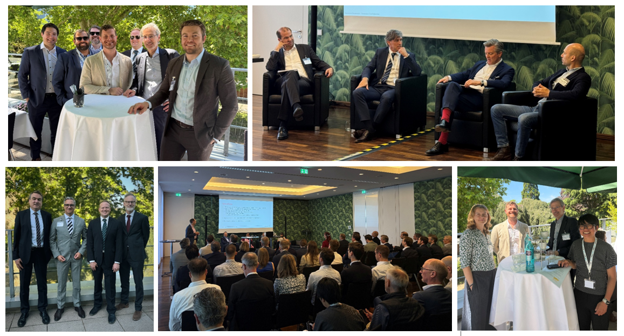
The European Practice Committee hosted its 13th annual European Practice Conference with the theme “Watch Your Words – Claim Interpretation, Estoppel, Information Sharing, Chat Bots, and Much More” on May 28, 2026 in Frankfurt, Germany at the Gesellschaftshaus Palmengarten, the site of the largest botanical garden in Germany. The one-day, in-person event featured insights into the Unified Patent Court (UPC) from UPC Judges RONNY THOMAS and STEFAN SCHILLING and panel discussions with senior attorneys and in-house counsel on AI tools, information sharing, claim construction and the doctrine of equivalents. The discussions focused on different approaches that might be taken in the U.S. and in Europe, at the EPO, and at the UPC. Attendees also enjoyed an evening reception prior to the event at the Frankfurt office of the hosting firm Leydig, Voit & Mayer, Ltd. Thank you to all our speakers and to Bardehle Pagenberg Partnerschaft MbB, Carpmaels & Ransford, and Fleuchaus & Gallo PartGmbB, for sponsoring the event.
 |