

 |
**MANDATORY STAY OF PROCEEDINGS UNDER 28 U.S.C. § 1659(A)(2) MUST BE FILED WITHIN 30 DAYS OF ORIGINALLY FILED COMPLAINT
Ascendis Pharma v. Biomarin Pharma. Inc., 26-1026 — Yesterday in an opinion by Judge STOLL, the Federal Circuit affirmed denial of Ascendis’s 28 U.S.C. § 1659(a)(2) motion for a mandatory stay of its declaratory judgment action pending a parallel ITC Section 337 proceeding initiated by BioMarin after Ascendis filed an NDA for a drug to treat achondroplasia. The mandatory stay would have foreclosed BioMarin from seeking a preliminary injunction upon FDA approval of Ascendis’s application. Ascendis argued the district court erred in dismissing its motion as rendered moot by a discretionary stay.
The Federal Circuit agreed because the types of stays were meaningfully different, but the error was harmless because Ascendis was not entitled to the mandatory stay. Ascendis had voluntarily dismissed its original DJ complaint and refiled for the purpose of requesting the mandatory stay within the required “30 days after the district court action is filed.” Under a common law principle “prohibiting the use of voluntary dismissal to accomplish indirectly what cannot be accomplished directly,” the triggering “district court action” must refer to an original complaint rather than a refiled one. Unlike statutes where Congress flagged “initial” pleadings because a party might not learn of relevant facts until later, no such qualifier was needed here because a party was aware of a parallel ITC proceeding unless not yet named as a respondent. Further, legislative history indicated that the 30-day deadline served “the important purposes of avoiding abuse and encouraging prompt adjudication” and allowing Ascendis to circumvent it did not fulfill those goals.
(1 to 4 stars rate impact of opinion on patent & trademark law)
LANDACRE MEETS WITH REP. MENG ON USPTO FUNDING, PATENT POLICY
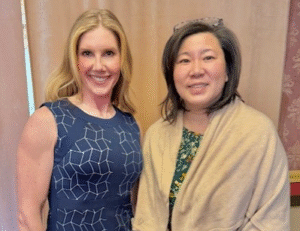
IPO Executive Director JESSICA LANDACRE met this week with Rep. Grace Meng (D-NY) to discuss key issues impacting the U.S. patent system, including USPTO fee retention, patent quality, and concerns surrounding proposals to expand patent-related fees.
Landacre emphasized IPO’s longstanding support for ensuring that the USPTO retains full access to all user fees it collects. She underscored that fee certainty is critical to maintaining high-quality patent examination, investing in examiner hiring and modernization efforts, and continuing progress in reducing the patent application backlog. Landacre also highlighted the important role of the House’s Commerce, Justice, Science (CJS) Appropriations Subcommittee, of which Meng is Ranking Member, in safeguarding these resources to support a strong, innovation-driven economy.
 |
COPYRIGHT OFFICE SEEKS COMMENT ON ALTERNATIVE REGISTRATION FEE STRUCTURES
Yesterday the U.S. Copyright Office published a request for comments on possible alternative fee structures for copyright registration services as it continues development of the Enterprise Copyright System (ECS) Registration platform. The CO asks for input on potential models such as subscription-style registration, tiered fees, or discounts for individual creators and small entities that could improve access to registration while maintaining cost recovery. The notice also seeks information about current registration practices, filing volumes, and applicant costs, and how alternative fee models might affect registration behavior. Comments are due June 24, 2026.
NEW ARTICLE ON IPO LAW JOURNAL DISCUSSES U.S. AND EUROPEAN CHEMICAL PATENTS
The IPO Law Journal has a new article entitled, “You Can’t (Always) Claim What You Didn’t Describe: U.S. and European Perspectives on Chemical Patents.” The white paper was authored jointly by KIMBERLY VINES (Stites & Harbison) and Prof. Dr. ALOYS HÜTTERMANN (Michalski Hüttermann & Partner). You can find the white paper on the IPO Law Journal. To submit an article for the Law Journal, email articles@ipo.org.
EDUCATE THE NEXT GENERATION OF INNOVATORS
 |
Support the next generation of innovators by donating to IPO Education Foundation’s Spring Fundraising Campaign. IPOEF has a goal of raising $15,000 by March 31 to scale IP education. Your support allows IPOEF to reach a larger audience by:
- Increasing educator’s access to IP Made Easy to bring IP education directly to classrooms
- Expanding IP Buddy’s reach to students and innovators nationwide
- Growing our Next Gen Innovators Toolkit in underrepresented communities
- Elevating awareness of IP’s role in driving innovation and prosperity
Donate today to help us make an impact on the next generation.
 |
“ORDINARY AND CUSTOMARY” OR “PLAIN AND ORDINARY” MEANING?
Patent Claim Construction — A READER believes the established standard for construing patent claims could have shifted a bit because of an incorrect choice of words. In its classic Phillips opinion (en banc 2005), the Federal Circuit said that to construe a claim you use the “ordinary and customary” meaning of the claim terms. USPTO rules also refer to “ordinary and customary” meaning. E.g., 37 CFR § 42.100(b). Several recent opinions by courts and USPTO judges, however, have used a “plain and ordinary” meaning standard.
Are the two phrases precisely the same? Merriam-Webster doesn’t list “plain” as a synonym for “customary.” Some doubt might exist about whether the phrases are identical. Judges should use the same words every time to describe how they construe claims. Uncertainty causes litigation.
Quote of the Week — “The only kind of writing is rewriting.” — Ernest Hemingway
Comments are invited. Click on “Curmudgeon” at the bottom of this column for my email address. Click here for the Curmudgeon Archives.
Your friend,
The Curmudgeon