

****SUPREME COURT HOLDS INTERNET SERVICE PROVIDER NOT CONTRIBUTORILY LIABLE FOR SUBSCRIBERS’ COPYRIGHT INFRINGEMENT
Cox Communications, Inc. v. Sony Music Entertainment, 2026-03-25 — Yesterday in an opinion by Justice THOMAS, the U.S. Supreme Court reversed a Fourth Circuit decision holding Cox Communications contributorily liable for copyright infringement by its subscribers. Sony Music Entertainment and other major copyright owners had sent Cox approximately 163,148 infringement notices over two years identifying IP addresses associated with infringing activity. A jury awarded $1 billion in statutory damages.
The Court held that a provider is contributorily liable for a user’s infringement only if it intended its service to be used for infringement, which requires proving the provider either (1) actively induced infringement through specific acts, or (2) provided a service tailored to infringement and not capable of commercially significant noninfringing uses. Although Cox was aware that some subscribers engaged in piracy, the Court explained that providing internet did not establish the necessary intent for secondary liability. Because the lower courts allowed the case to proceed without requiring proof of purposeful encouragement of infringement, the Supreme Court vacated the judgment and remanded the case for further proceedings.
Justice SOTOMAYOR, joined by Justice JACKSON, concurred in the judgment but cautioned that the Court’s reasoning could narrow the scope of contributory copyright liability in ways that could affect future cases involving online service providers.
(1 to 4 stars rate impact of opinion on patent & trademark law)
HOUSE IP SUBCOMMITTEE HOLDS USPTO OVERSIGHT HEARING
Yesterday the House Judiciary Subcommittee on Courts, Intellectual Property, Artificial Intelligence, and the Internet held a hearing on Oversight of the U.S. Patent and Trademark Office. USPTO Director JOHN SQUIRES testified that the agency is focused on deploying artificial intelligence tools to modernize patent examination, reduce the application backlog, and strengthen the quality of issued patents. He described the USPTO as the Department of Commerce’s “Central Bank of Innovation” and praised the agency’s workforce as the best in the world at what they do. Squires also said the USPTO is preparing to reconstitute the Patent Public Advisory Committee (PPAC), including the appointment of the statutorily required independent inventor member.
Several subcommittee members questioned Director Squires about the USPTO’s notice of proposed rulemaking addressing rules of practice governing inter partes review proceedings before the Patent Trial and Appeal Board. Some members raised concerns that the proposed rule could limit access to PTAB review and shift more patent disputes to district court litigation, potentially increasing litigation. Other members emphasized concerns about repeated PTAB challenges to issued patents and the burden such challenges can impose on patent owners, particularly smaller entities. Director Squires said the proposal is intended to promote efficiency and finality in AIA trial proceedings by discouraging serial challenges while allowing multiple parties to join a single petition. He noted that the USPTO has received more than 11,000 public comments on the proposal and is reviewing them as it considers next steps.
Members also raised questions about foreign participation in the patent system and potential national security risks. Director Squires said the USPTO has strengthened real-party-in-interest disclosure requirements and taken steps to restrict foreign sovereign actors from participating in certain PTAB proceedings. Lawmakers also discussed the agency’s use of AI tools in examination, workforce morale at the USPTO, and the importance of extending the Office’s fee-setting authority to maintain operational stability. In response to a question about reports that the Department of Commerce had considered imposing a value-based “patent tax.” Squires responded that the USPTO has not pursued such a proposal and echoed statements by Commerce Secretary HOWARD LUTNICK that the agency is not evaluating patent valuation as a basis for fees.
A video of the hearing is available on the Judiciary Committee’s website.
 |
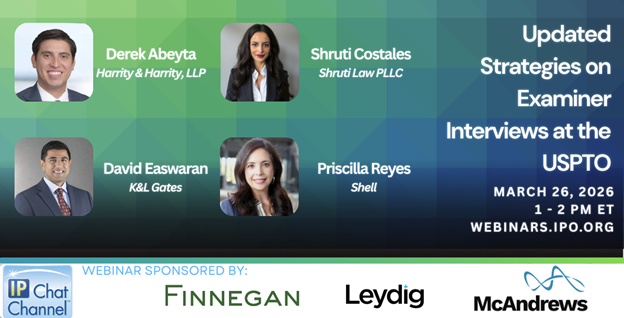
TODAY ON THE IP CHAT CHANNEL™: UPDATED STRATEGIES ON EXAMINER INTERVIEWS AT THE USPTO
Join the IP Chat Channel™ today at 1:00pm ET for a webinar that will provide a practical and strategy-focused discussion on what has changed at the USPTO as it pertains to updates to the rules, processes and expectations surrounding examiner interviews, why it matters, and how to adapt. The panel will compare the new procedures with prior practices, highlight key pitfalls and opportunities, and provide actionable strategies for securing more effective, efficient, and successful examiner interviews.
 |
IP Chat Channel™ webinars are free for IPO members. Advance registration is required. CLE offered in most states.